Business. Life. Balance.
City of Eau Claire Economic Development Division

The Workforce in Eau Claire

Eau Claire has a very diverse workforce. From highly-skilled to non-skilled workers, Eau Claire can offer any company a wide range of options. The city of Eau Claire has over 65,000 residents. The city also shares its northern border, and its workforce, with Chippewa Falls (pop. 13,515). Eau Claire County and Chippewa County are considered a metropolitan statistical area by the federal government, a designation given to areas with high degrees of social and economic integration. In fact, over 37% of Chippewa County's workers commute to Eau Claire.

The Eau Claire area population is well educated with more than quarter of the population possessing a college degree (36.3%), 55.1% have had college experience and 89.4% have completed a high-school degree.

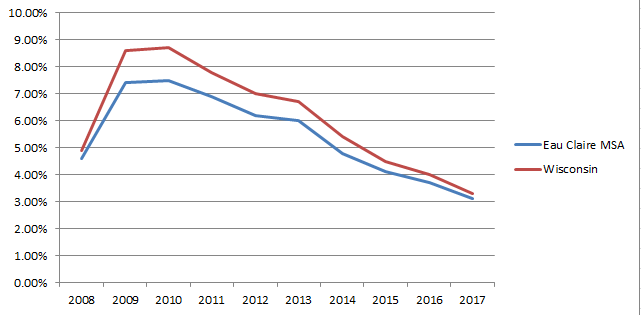
The labor force participation rate is the percentage of an area's 16 years and older non-institutional population that is in the labor force. Eau Claire's was an estimated 68.9% in 2007, slightly higher than the statewide average of 68.7%. Of Eau Claire's labor force in 2007, about 82,000 residents were employed while about 5,200 people were unemployed. The unemployment rate, which is the unemployed as a percentage of the total labor force, was 4.1% annually in 2007. Rates tend to fluctuate throughout the year, from highs in February and March, to typical lows in October.

Education and health occupations provide the greatest share of employment in Eau Claire County. These occupations, the backbone of the massive service industry, employ 24% of Eau Claire's workforce. Eau Claire County, employs a small army of these workers to keep offices running throughout the area.

Eau Claire County's average wage in 2006 was $31,314, which is about 91% of the average wage in Wisconsin of $34,405. Eau Claire's largest industry, by employment and even more so by total payroll, is Education and Health; the average wage in this industry, $41,413, is 4.6% higher than the state average. In contrast, the next largest industry super-sector, Trade, Transportation, and Utilities, pays only 81.7% of the statewide average.

For more information, check out the Wisconsin Department of Workforce Development.